
How to Fix Burnout Naturally: Reset Your Cortisol in 30 Days
Introduction
You’re not burnt out because you’re weak. You’re burnt out because your cortisol is broken.
Burnout isn’t about needing more vacation days or a better work-life balance. It’s a biological breakdown that happens when your stress hormone—cortisol—gets stuck in the wrong pattern for so long that your body forgets how to regulate itself.
You know the feeling:
- Exhausted all day, but wired and can’t sleep at night
- Brain fog so thick that simple tasks feel impossible
- Sugar cravings that hijack your afternoons
- You rest all weekend, but Monday feels exactly the same.
That’s not laziness or weakness. That’s cortisol dysregulation.
Here’s the good news: your cortisol rhythm can be reset. It doesn’t take six months off work or a complete life overhaul. It takes one simple morning routine, done consistently for 30 days.
In this article, you’ll learn exactly how to fix burnout by resetting your cortisol naturally:
- Why burnout is actually a cortisol problem (not a willpower problem).
- The 4 morning steps that reset your cortisol rhythm.
- What to expect during your 30-day burnout recovery timeline.
By the end, you’ll have a clear plan to go from “exhausted and wired” to “steady energy and normal sleep” in one month.

Want a Personalized Burnout Recovery Plan?
Get a personalized analysis that identifies YOUR specific imbalances and creates a custom recovery protocol tailored to your body.
Why Burnout Is Actually a Cortisol Problem
Burnout feels like a mental thing—like you just can’t push through anymore. But what’s actually happening is physical. Your cortisol rhythm has broken down.
What Cortisol Actually Does
Cortisol is your body’s primary stress hormone, but referring to it in this way makes it sound like the enemy. It’s not. When cortisol is working properly, it’s what gives you energy in the morning, helps you focus during the day, and allows you to sleep deeply at night.
In a healthy person, cortisol follows a predictable pattern:
- Morning (6-8am): Cortisol spikes to wake you up and give you energy
- Afternoon: Gradually decreases as the day goes on
- Evening (9pm+): Drops to its lowest point so you can sleep
his is called your cortisol rhythm, and it’s controlled by your circadian clock: the same internal system that tells your body when to be awake and when to sleep.
What Happens When Cortisol Breaks Down
When you’re under chronic stress for weeks or months, this rhythm gets disrupted. Your body stops knowing when to be “on” and when to be “off.”
Here’s what broken cortisol looks like:
| Normal Cortisol Pattern | Burnout Cortisol Pattern |
|---|---|
| High in the morning (energy) | Flat or low all day (no energy) |
| Drops throughout the day | Stays elevated into night (can’t sleep) |
| Low at night (deep sleep) | Spikes at random times (wired and tired) |
| You wake up refreshed | You wake up exhausted |
This is why rest doesn’t fix burnout. Your cortisol rhythm doesn’t reset just because you take a weekend off or sleep in. It needs specific signals—especially in the morning—to remember how to regulate itself.
That’s where the 4-step morning routine comes in. But first, let’s check if this is actually what you’re dealing with.
How to Lower Cortisol: The 4-Step Morning Reset
Your cortisol rhythm is set in the morning. Fix your morning, and you fix your entire day—and eventually, your entire stress response system.
Here are the 4 steps that reset cortisol naturally. Do these every day for 30 days, and your body will remember how to regulate itself again.
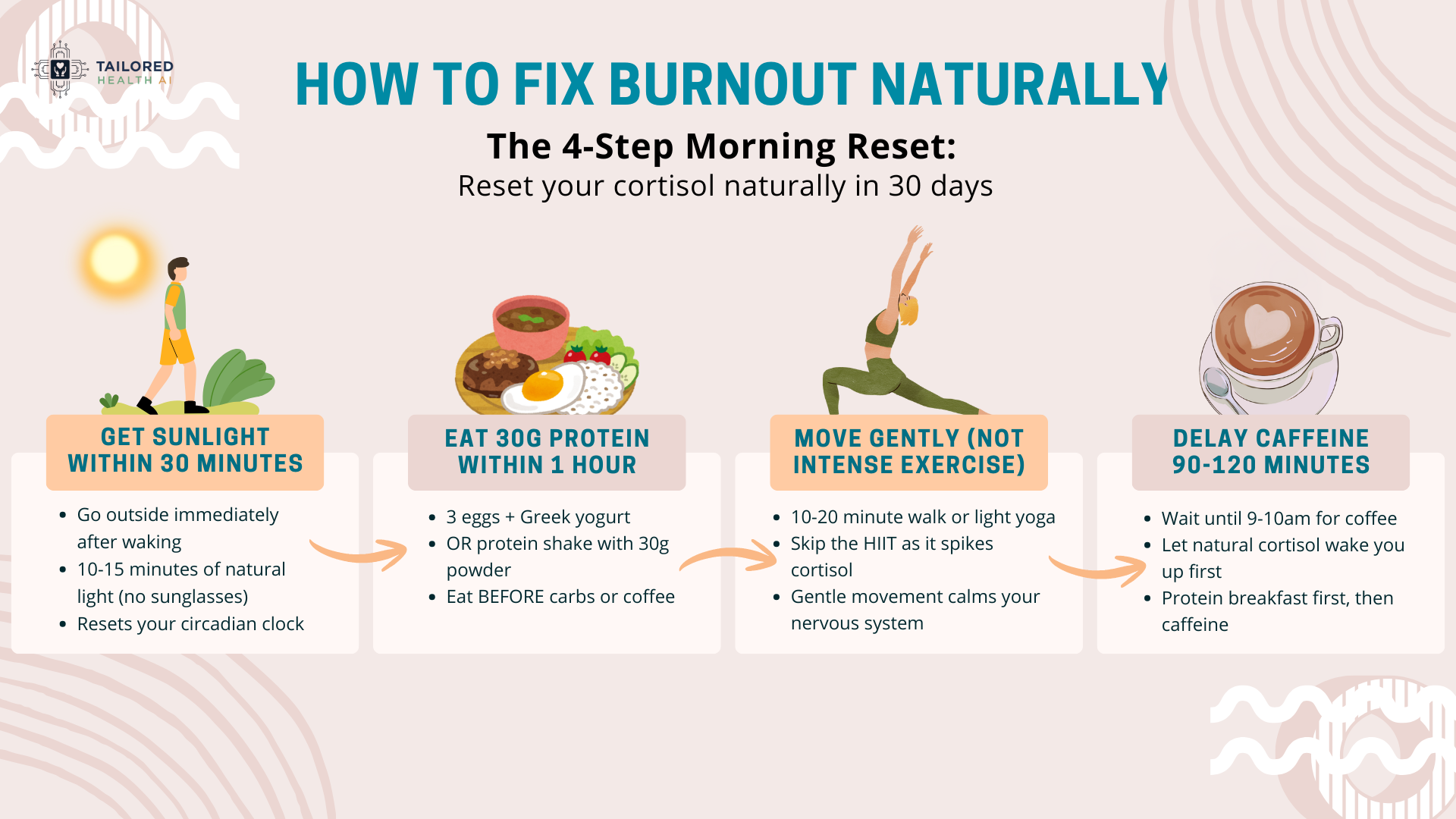
Step 1: Get Sunlight Within 30 Minutes of Waking
Morning sunlight is the most powerful signal to your brain that says, “It’s daytime—cortisol should be high NOW, and low tonight” (WebMD). This resets your circadian clock, which controls your cortisol release throughout the day.
How to do it:
1. Head outdoors within the first 30 minutes after you wake. A short stroll, morning coffee on the deck, anything works. 2. Aim for 10-15 minutes of direct sunlight exposure daily. 3. Even on cloudy days, it still works.
Step 2: Eat 30g of Protein Within 1 Hour of Waking
Major blood sugar crash spikes your cortisol (Harsh Hospitals). When you eat protein first thing, you stabilize your blood sugar, which keeps cortisol from spiking erratically. This prevents the 2pm crashes and constant sugar cravings.
How to do it:
1. Aim for 30g of protein (not just “some protein”)
2. Examples: 3 eggs, 1 cup Greek yogurt, protein shake with 30g powder
3. Eat this BEFORE carbs or coffee.
4. Within 1 hour of waking up
Step 3: Move Gently (Not Intense Exercise)
Here’s what most people get wrong: intense exercise raises cortisol. HIIT and long runs can exacerbate burnout when your cortisol levels are already elevated (Stanford). Gentle movement, on the other hand, lowers cortisol naturally and helps your nervous system shift into “calm and restore” mode.
How to do it:
1. 10-20 minute walk (not a run) 2. Gentle yoga or stretching 3. Light movement that doesn’t leave you exhausted 4. Save intense workouts for AFTER your cortisol resets (month 2+)
Step 4: Delay Caffeine for 90-120 Minutes After Waking
Your natural cortisol peaks in the first 90 minutes after waking. When you drink caffeine on top of that peak, you spike cortisol even higher—which leads to anxiety, jitters, and crashes later (NIH). By waiting, you let your natural cortisol wake you up, and then caffeine sustains your energy without the spike. (Note: If you’re a heavy coffee drinker, you might not feel the spike as much, but your stress system still feels the pressure.)
How to do it:
1. Wait until 9-10am to have your coffee (if you wake at 7-8am) 2. Eat your protein breakfast first. 3. Try herbal tea or water in the meantime. 4. You’ll notice you don’t “need” coffee as desperately after week 2
These 4 Steps Work—But What If You Need More?
Tailored Health AI analyzes your unique health data and creates a personalized protocol that addresses the ROOT cause of your burnout, not just the symptoms.
What to Expect: Your 30-Day Cortisol Reset Timeline
Resetting cortisol takes time. Here’s what happens week by week:
| Timeline | What’s Happening | What You’ll Notice |
|---|---|---|
| Week 1 | Body recognizes new signals, circadian clock starts recalibrating | Sleep improves slightly (fall asleep 10-15 min faster), mornings less brutal, building the habit |
| Week 2 | Cortisol pattern stabilizing, blood sugar balancing | Afternoon crashes reduce, brain fog lifts, sleep deepens, energy more consistent |
| Week 3-4 | Cortisol rhythm resetting, stress response regulating | Wake with natural energy, handle stress better, focus returns, sleep restorative, cravings drop |
| Day 30+ | Cortisol rhythm restored, nervous system balanced | Steady energy all day, deep sleep, stable mood, ready for intensity again |
Important: Recovery isn’t linear. You might have tough days. That’s normal—the trend matters, not perfection.
Ready to Fix Your Burnout for Good?
Your stress triggers, sleep patterns, and energy crashes are unique. A personalized approach gets you results faster—and makes them last.
FAQs: Your Common Questions Answered Here
2. 1 cup Greek yogurt = ~20g (add a scoop of protein powder)
3. 1 scoop whey/plant protein powder = ~20-25g (blend with milk/yogurt)
4. 4 oz chicken breast = ~35g
Track your food intake for a week to learn about portions, then keep a close eye on it.
⚠️Important Information
This article is for educational purposes only and is not medical advice. Always consult with a qualified healthcare provider before making decisions about your health, diagnosis, or treatment.